















 0 comments





Einstein GPT was Salesforce’s 2023 name for generative AI inside its CRM, announced on 7 March 2023. Salesforce has since dropped the GPT suffix and now groups its AI assistants and agents under Agentforce, while “Einstein” still covers predictive AI such as lead scoring and forecasting.
So is Einstein GPT the same as ChatGPT? No. It was a Salesforce layer that sent CRM-grounded prompts to large language models from partners such as OpenAI, with a Trust Layer in between to mask sensitive data. This guide covers what it did, what replaced it, and what to look at in 2026.
Quick answers:
- What it was: Salesforce’s first generative AI layer for CRM (2023).
- What it is called now: Einstein (predictive AI) plus Agentforce (assistants and agents).
- What to use today: Agentforce and Einstein features inside the Salesforce clouds you already own.
Einstein GPT, Einstein Copilot, Agentforce: what changed and when
| When | Name | What happened |
|---|---|---|
| 7 Mar 2023 | Einstein GPT | Salesforce announces generative AI for CRM, built with partners such as OpenAI |
| 2023 to 2024 | Einstein | Salesforce stops using the GPT suffix; features ship as “Einstein” generative AI |
| Apr 2024 | Einstein Copilot | The conversational assistant is rebranded and rolled out |
| 12 Sep 2024 | Agentforce | Salesforce unveils Agentforce, its autonomous agents platform |
| Jan 2025 | Agentforce (Default) | The Einstein Copilot agent type is renamed with no change in functionality |
| Jun 2025 | Agentforce 1 Editions | Replace the earlier Einstein 1 Editions |
| Oct 2025 | Agentforce 360 Platform | Einstein 1 Platform becomes Salesforce Platform, then Agentforce 360 Platform; Data Cloud becomes Data 360 |
In short: Einstein GPT no longer exists as a product name. If you meet it in older guides, read it as “Salesforce generative AI”, now delivered through Einstein features and Agentforce. For a side-by-side of the two, read our Agentforce vs Einstein comparison.
Sources: Salesforce newsroom (7 Mar 2023 announcement), Salesforce release notes (Copilot to Agentforce rename), Salesforce Agentforce launch (12 Sep 2024).
What is Generative AI, and how does Salesforce use it?
Generative AI creates new text, images, or code from patterns learned in training data, instead of following fixed rules. In a CRM, it drafts emails, summarises cases, and answers questions in plain language. The risks are accuracy and privacy, which is why Salesforce wrapped its version in a Trust Layer.
Meet the new AI Powerhouse: Salesforce Einstein GPT
When did Salesforce launch Einstein GPT?
Salesforce announced Einstein GPT on 7 March 2023 and described it as generative AI for CRM across sales, service, marketing, commerce and IT. It entered limited pilots first, so most teams only saw it later under the Einstein and Copilot names. This innovation, part of the new Einstein generation, brings forth AI-powered content for various interactions in sales, service, marketing, commerce, and IT.
What was Einstein GPT, exactly?
Einstein GPT combined two things. The first was Salesforce’s existing predictive Einstein models, which score leads and forecast outcomes. The second was generative AI from large language models, which write and summarise content using your CRM data. Salesforce said at launch that Einstein ran over 200 billion predictions a day across its clouds (Salesforce’s own March 2023 figure). It did not simply merge with ChatGPT; it routed prompts to partner models through the Einstein Trust Layer. This integration enhances efficiency and satisfaction across different domains such as sales, development, marketing, and services.
What is the Einstein Trust Layer?
The Einstein Trust Layer is the security and grounding layer that sits between your Salesforce data and the language model. According to Salesforce’s developer documentation, it provides:
- Grounding in CRM data, so answers use your records
- Masking of sensitive data, such as Social Security numbers
- Toxicity detection on generated output
- An audit trail and feedback
- Zero data retention agreements with third-party model providers
Salesforce lets customers choose partner models, including OpenAI and Anthropic, or bring their own. Check your own contract and Salesforce’s current help pages for the exact scope, because masking and retention terms can differ by feature.
How did Einstein GPT affect sales, service and marketing?
Einstein GPT transforms critical Customer Experience (CX) functions, demonstrating profound impacts in various domains:
1. Marketing Automation
Einstein GPT tailors campaigns to individual subscriber profiles. It can draft campaign copy and audience-specific variations from your own data. It also automates multi-channel orchestration based on real-time user activity.
2. Sales Enablement
The automatic scoring of leads by Einstein GPT helps reps decide which leads to call first, based on past conversion patterns in your org.
3. Service & Support
Using advanced Natural Language Processing (NLP), Einstein GPT can draft replies, summarise cases, and suggest knowledge articles, so agents spend less time on repetitive work and can intelligently route complex issues to the appropriate agents.
4. Commerce
The tool customizes product recommendations, promotions, and merchandising by analyzing historical and real-time data, including purchases, searches, and page activity.
5. Market Research
Einstein GPT’s generative capabilities extend to creating customer surveys and summarizing insights from market data.
6. Business Process Automation
Einstein GPT automates tedious administrative tasks across sales, service, and marketing, allowing staff to focus on high-ROI activities.
Also read how to maximize sales productivity with Salesforce automation!
How does Einstein GPT work?
When a user asked Einstein GPT a question, the request went through four steps:
- Salesforce pulled the relevant records from your org (grounding).
- The Trust Layer masked sensitive fields in the prompt.
- The prompt went to a language model, which drafted the answer.
- The Trust Layer checked the answer for toxic content, restored the masked data and logged the exchange.
Predictive Einstein models, such as lead scoring, ran separately and fed their results into the same screens.
How does Einstein GPT scale CRM operations?
Einstein GPT cleanly combines the strong features of Salesforce’s CRM data with generative AI. This integration gives rise to an innovative form of intelligent CRM capable of engaging customers in deeply personalized ways while efficiently automating intricate tasks.
By merging Salesforce’s extensive CRM capabilities with advanced AI through Einstein GPT, a transformative shift occurs in CRM operations, enabling highly personalized customer interactions and streamlined automation of complex tasks.
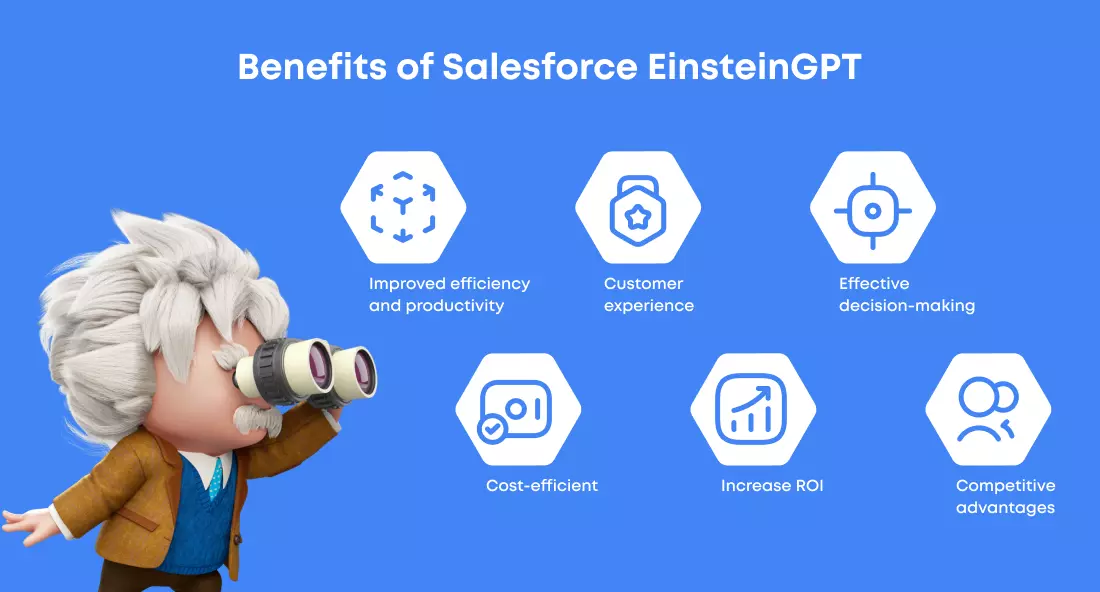
Source: Salesforce newsroom, “Salesforce announces Einstein GPT” (7 Mar 2023)
-
-
AI-Driven Personalization
-
Leverages granular customer insights for tailored recommendations, content, and offers across channels. Personalised content tends to perform better than generic messaging, so test it on one segment first.
-
Predictive Lead Management
Uses lead scoring to rank leads by likelihood to convert, based on your own history, identifying and prioritizing high-potential leads.
-
Streamlined Customer Experience
Employs chatbots with advanced NLP to answer routine questions and hand harder ones to a person. Intelligent automation handles repetitive tasks, freeing staff for high-value engagements.
-
360-Degree Customer Intelligence
Analyzes interactions across channels for complete context, anticipating needs, easily routing issues, and proactively delivering support.
-
Immersive Brand Experiences
Utilizes Generative AI for customized landing pages, product demos, and content tailored to individual customer preferences.
What could Einstein GPT do for each team?
These were the main uses at launch. Each now lives under a current product name, shown in brackets.
-
Einstein GPT for Developers
Einstein for Developers (now Agentforce for Developers). An AI assistant that helps write Apex code and answer coding questions inside the IDE.
-
Einstein GPT for Sales
Drafting emails, summarising accounts and calls, and suggesting next steps from CRM data (now Einstein for Sales and Agentforce for Sales). To see an agent in action, read how the Agentforce SDR Agent works.
-
Einstein GPT for Service
drafting replies, summarising cases and creating knowledge articles from resolved cases (now Einstein for Service and Agentforce for Service).
-
Einstein GPT for Marketing
generating email, landing page and campaign copy inside Marketing Cloud (now Agentforce for Marketing).
-
Einstein GPT for Slack Customer 360 Apps
Slack: summaries, search and AI answers in Slack channels (now Slack AI and Agentforce in Slack). The 2023 ChatGPT app for Slack was a separate OpenAI product.
In summary, the use cases survived; the product names changed.
Challenges and Limitations for Einstein GPT
-
Bias and Ethical Concerns:
One significant challenge for a Salesforce consulting company using Einstein GPT is the potential for bias in its responses. Since the AI relies on training data, it may inadvertently inherit biases present in that data, leading to biased interactions with customers. Vigilance and active monitoring are essential to identify and address any biases, ensuring fair and ethical use in customer interactions.
-
Complexity of Training:
Most teams do not train a model. The work is cleaning data, choosing which objects to ground on, writing prompt templates, and testing outputs.
-
Security and Privacy Concerns:
Security depends on how the model is reached. The Trust Layer masks sensitive fields, and Salesforce has zero-data-retention agreements with its model partners, but you still decide which fields the AI can see, who can use it, and where outputs are stored. Review these against GDPR and CCPA with your own legal team. Reliable security measures must be implemented to protect customer information and prevent potential data breaches. Compliance with data protection regulations, such as GDPR and CCPA, is essential for maintaining customer trust and ensuring legal compliance. Our guide to Salesforce security and compliance covers GDPR, HIPAA and SOC 2.
-
Dependency on Data Quality:
The effectiveness of Einstein GPT relies on the quality and diversity of the training data. Incomplete, inaccurate, or biased training data can result in suboptimal performance and unreliable outputs. Therefore, Salesforce consulting companies must prioritize data cleaning and validation processes to ensure the AI receives accurate and reliable training data, emphasizing the importance of data quality for AI success.
The Future of CRM with Einstein GPT
Einstein GPT is a breakthrough in CRM and AI-driven customer interactions. As technology advances, so does the potential of Einstein GPT. The direction has moved from assistants that answer questions to agents that complete tasks, such as resolving a case or qualifying a lead. That is what Agentforce is built for. Before you adopt any of it, check three things: data quality, permissions, and who reviews the output.
Final Note
Einstein GPT was the first step in Salesforce’s generative AI roadmap. The name is gone, but the ideas continue in Einstein and Agentforce. If you are choosing what to deploy now, start with one workflow, such as case summaries or lead follow-up, measure it, then expand
Connect with DianApps, a Salesforce development company, to explore how we can help you gain access to Einstein GPT for your business.
At DianApps, we specialize in integrating CRM and Salesforce systems and understanding the potential of Salesforce’s Einstein GPT. Our focus is on empowering businesses to use these technologies fully, ensuring a sustainable, efficient, and forward-thinking approach to customer relationship management services.
 0 comments






Your email address will not be published. Required fields are marked *